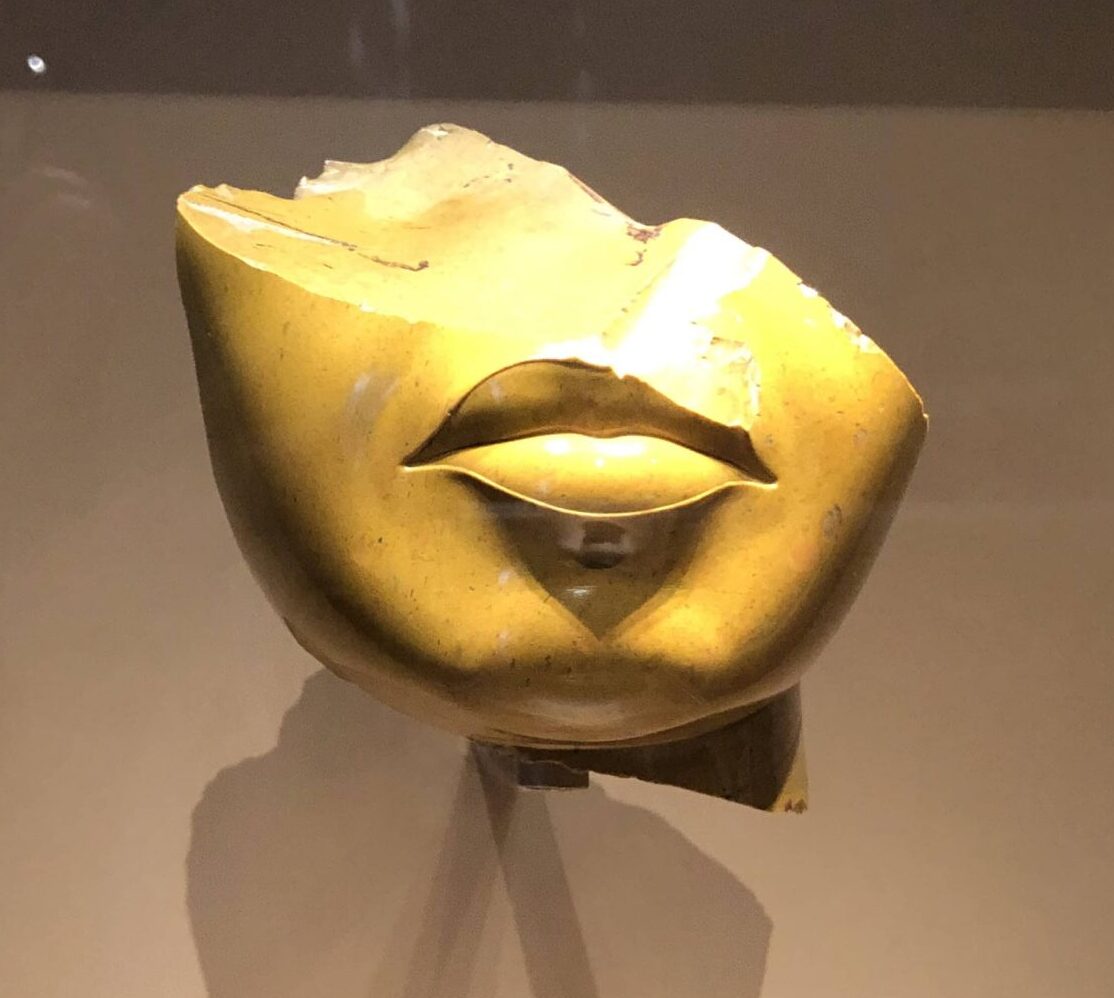
Cover image: Fragment of a Queen’s Face, Egyptian, New Kingdom, c. 1386-1330 BCE. The Metropolitan Museum of Art, New York. Photo by the author.
I’ve recently read The Stolen Queen, Fiona Davis’s latest novel which largely takes place at the Metropolitan Museum of Art. While the book itself didn’t really resonate with me, it did get me thinking about the artwork that inspired it. This is the Met’s Fragment of a Queen’s Face, a small, broken statue that shows the lower half of an ancient Egyptian woman’s face. Davis expressly identifies this as the basis for her fictional “Cerulean Queen” in her author’s note at the end of the book.
Fragment of a Queen’s Face is iconic and has lots of fans, including the book’s two major characters. I completely understand why people connect so strongly to it, though I don’t necessarily feel that pull myself. It’s not simply the rarity of a sculpture that only depicts the lower half of a face, though that surely contributes. The statue’s fragmentary nature directs viewers to hyper-focus on the surviving features (the elegant chin and full, contoured lips) while suggesting a tantalizing mystery about its original appearance.
Viewing in person
During a recent visit to the Met, I spent some time with this object, on display in gallery 121 of the Egyptian Wing, to decide if I think it merits the hype. My answer is a solid maybe. This artwork really is quite small (roughly life-sized for half a face), and I don’t know that I would have been drawn to it if I wasn’t expressly looking for it. I’m not saying that tiny objects can’t be impactful – after all, I have a special love of even smaller medieval treasures – but this is not an artwork that will capture you from across the room. It competes with other, larger objects for your attention, although its location beside a doorway means that you have to at least pass it on your way into the next gallery.
Something that did really grab my attention once I was near the object was incredible yellow jasper from which it’s carved. (This is the big difference between the real artwork and the fictional one, since Davis tells us the Cerulean Queen is made of lapis lazuli and is thus blue as its name suggests.) Under the display lighting, the statue looked almost golden and slightly glowy. The polished surfaces of the queen’s face sparkle with a pseudo-metallic sheen that is somewhat visible in my photo but is much more captivating in person. I’m also fascinated by the long reddish mark, possibly a vein in the stone, in the break above her right cheek. In fact, I found the color, texture, and shine of the statue to be more interesting than the partial face it depicts, although this may only be because those features look so different in person as compared to the fairly matte photo on the museum’s website.
My perspective
I’m genuinely not sure if this is a hot take, but I doubt this sculpture would get nearly so much attention if it were more complete. Yes, it was probably pretty great, but in contrast to what a lot of other people seem to believe, I don’t think you can project the impression given by the fragment onto the whole and assume this was the most gorgeous sculpture ever. After spending time with the sculpture in person, I stand by this opinion.
It’s always tricky to view an artwork that’s clearly lacking critical elements. You are literally only seeing part of the picture, which is definitely going to be skewed and almost certainly impoverished if the losses are substantial enough. With Fragment of a Queen’s Face, it’s impossible to overlook the fact that so much is missing, but that’s the way we’re used to seeing her. Whether we realize it or not, our idea of this statue is completely dependent on its current state, and any hypothetical reconstruction is unlikely to fit the impressions we’ve collected from the fragment. But maybe that’s why the mystery is just so compelling.
If you’re interested in Fragment of a Queen’s Face, I recommend watching sculptor Barry X Ball’s episode of The Artist Project, a Met production where artists speak about Metropolitan Museum of Art objects.