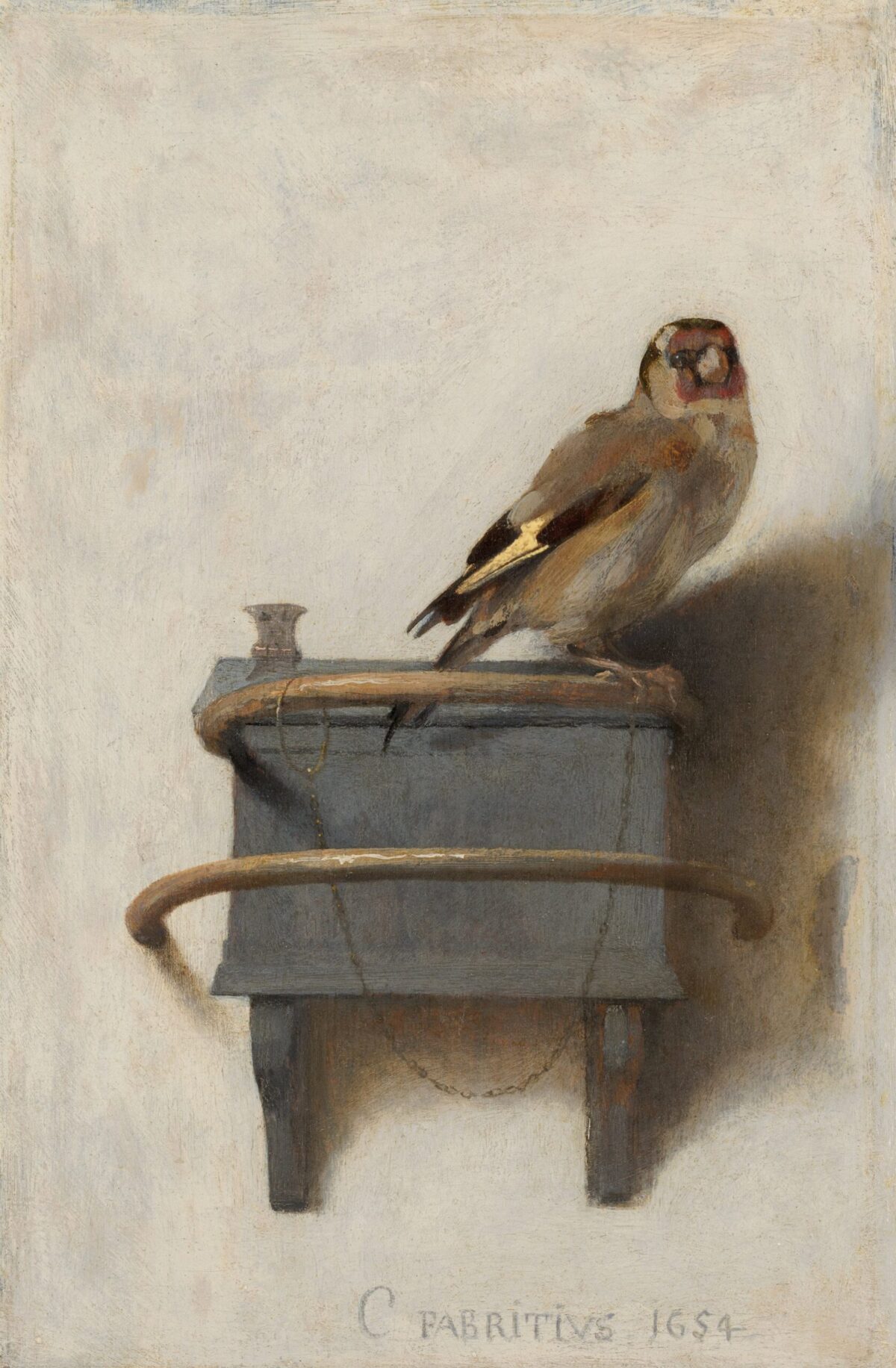
Carel Fabritius, The Goldfinch, 1654. Mauritshuis, The Hague, Netherlands. (Public Domain via Wikimedia Commons.)
I recently read and enjoyed The Goldfinch, the Pulitzer Prize-winning novel by Donna Tartt that was inspired by the painting of that same name. I picked it up after enjoying Tartt’s other famous novel The Secret History. In this article, I briefly discuss both the book and the painting before giving my thoughts about what makes this small artwork so fascinating to so many people.
The Book
The Goldfinch tells the story of a young boy named Theo who lives in New York City with his mother until she dies in a terrorist attack at the Metropolitan Museum of Art. (As someone who grew up near NYC around 9/11 and now visits the Met a lot, this part really upset me, to be honest.) To oversimplify a complicated story, Theo ends up leaving the museum with the painting The Goldfinch, which was starring in the exhibition at the center of the attack.
The rest of the book follows Theo’s life over roughly the next decade, dealing with the aftermath of his mother’s death as he and the painting move from prep school in New York to a dreary existence in Las Vegas and beyond. At 771 pages, The Goldfinch is a lengthy read that evokes Theo’s grief, desperation, and self-destruction throughout. For the most part, I like this leisurely quality of Tartt’s work, which creates atmosphere, takes you on a journey, and feels different from the shorter and more direct nature of many popular novels. That said, it did challenge my attention span at times, so it may not be to everyone’s taste.
This is a story that features an artwork but isn’t actually about that artwork. I think that’s why I liked it despite not usually enjoying fiction about real art and artists. The painting recurs throughout the novel, but it’s not important to the plot until near the end. The love of art and antiques definitely pervades the story – Theo and his mother are both art lovers, he eventually becomes an antique furniture dealer, and art objects appear throughout the text – but the painting itself isn’t an integral part of the story. Instead, it is one of the many vehicles the novel uses to explore its actual themes of grief, guilt, and holding up versus moving forward.
The Painting
The original The Goldfinch is a small oil painting by Dutch artist Carel Fabritius (1622-1654). It depicts a small brown, red, and tan bird perched elegantly on a grey-blue feeding box against a plain, cream-colored wall. A thin metal chain attached to the bird’s leg tethers the creature to his habitat. Fabritius’s signature and the date 1654 appear prominently in the lower right-hand corner. Although its body is seen in profile, showing a dark wing with a brilliant gold stripe, the bird turns its face to look almost directly at the viewer, giving a striking sense of intelligence and dignity. This feels more like a portrait than the typical animal painting, and I think this accounts for much of the image’s success.
The painting is now at the Mauritshuis alongside more famous paintings like Rembrandt’s The Anatomy Lesson of Dr Nicolaes Tulp and Vermeer’s Girl with a Pearl Earring. This is fitting, since Rembrandt was Fabritius’s teacher, and some people suspect that Vermeer was his student, although there doesn’t seem to be much evidence for the latter. Fabritius only left behind about twelve paintings for posterity because he died in 1654 at age 32 in a freak explosion that also destroyed many of his paintings as well as plenty of other people in Delft. Commentators often like to parallel the explosion in the book to the one that ended Fabritius’s life in reality, and I have no doubt that the artist’s early, tragic demise adds to the painting’s modern-day intrigue.
The painting The Goldfinch is at least as well known as the novel, but it’s difficult to determine how much it owes its celebrity to the book. In 2014, the year after the novel’s release, over 200,000 people visited the Frick for a loan exhibition from the Mauritshuis that included this painting.1 (I’m really asking myself why I wasn’t one of them!) In the novel, Tartt describes the painting’s visual and emotional appeal in really compelling ways, so I totally believe that the book make people eager to see the painting in person. That said, I suspect The Goldfinch already had some prior level fame, although art history survey books don’t tend to mention it, preferring to include Fabritius’s self portrait instead.
Why so popular?
Beyond its presence in an esteemed work of fiction, tragic backstory, and connection to more famous artists, I think the elegant simplicity and accessible subject matter of The Goldfinch also contribute to the painting’s appeal. It depicts a familiar living creature we can relate to in uncomplicated ways, without feeling like we need to work hard to make sense of some hidden meaning. I’m not saying there are no deeper meanings to be found here, just that you don’t need to do extensive interpretation to have a fulfilling experience.
In addition, the uncluttered composition with its plain background and simple perch gives the scene a timeless quality that separates it from the aproned milkmaids, tavern scenes, and ornate still life paintings most common to the Dutch Golden Age. Vivid and lifelike while also being lyrical and painterly, the goldfinch itself is portrayed in a way that gives it a real sense of personality and presence. I think that, above all else, is why people find this small and simple artwork so compelling and memorable.
Sources
- “Carel Fabritius: The Goldfinch“. Mauritshuis website.
- Jones, Jonathan. “Clipped wings: the tragic true story of The Goldfinch“. The Guardian. October 21, 2016.
- Sooke, Alastair. “The intriguing mystery of The Goldfinch“. BBC website. December 12, 2016.
Notes
- Jones, Jonathan. “Clipped wings: the tragic true story of The Goldfinch“. The Guardian. October 21, 2016. ↩︎