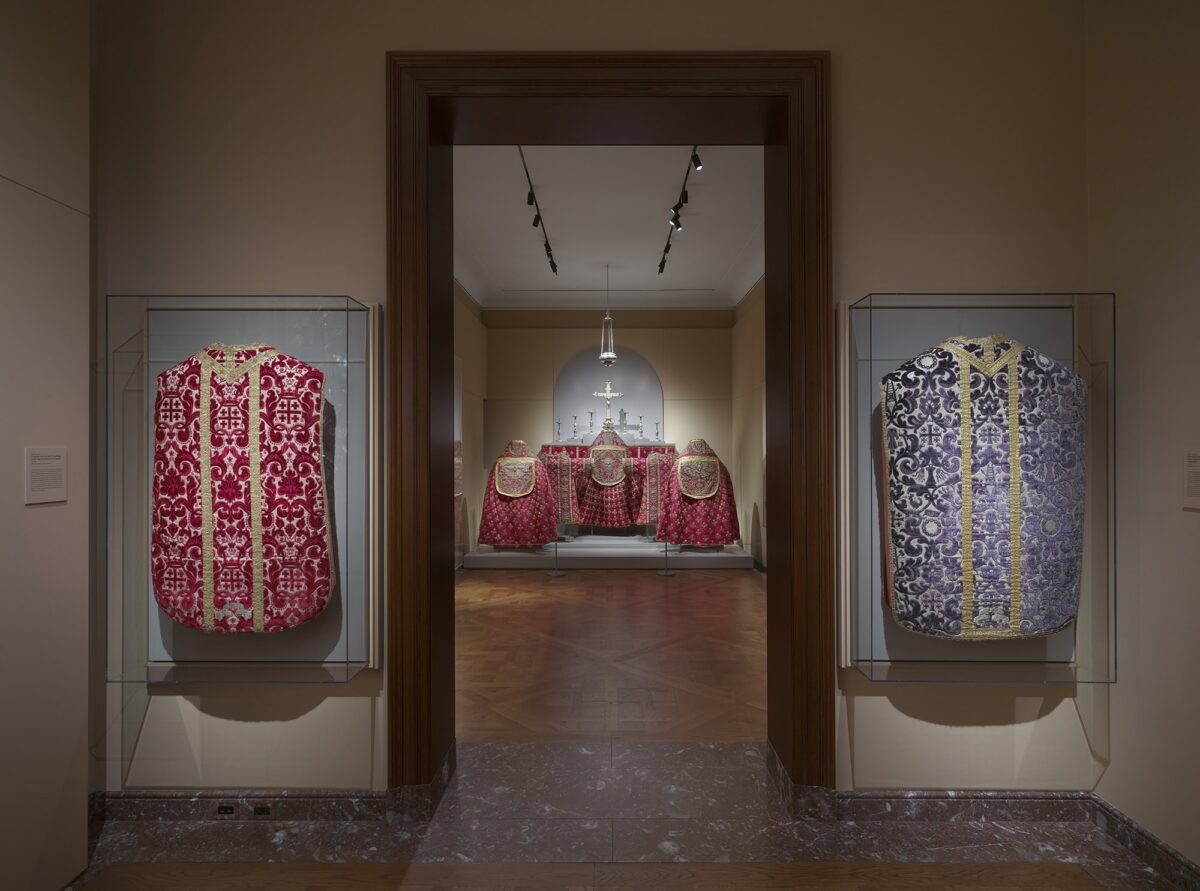
Cover image: Installation view of To the Holy Sepulcher: Treasures from the Terra Sancta Museum at The Frick Collection, showing two Chasubles (Milan or Genoa, probably 1600) flanking the entry to a room with works from the Kingdom of France, donated by King Louis XIII, courtesy the Terra Sancta Museum, Jerusalem. Photo: Joseph Coscia Jr.
This past weekend, I visited the Frick Collection in New York. Both the city and the museum were absolutely packed with pre-Christmas merriment, but I managed to get in to see two fantastic exhibitions – To the Holy Sepulcher: Treasures from the Terra Sancta Museum and Flora Yukhnovich’s Four Seasons.
To the Holy Sepulcher
To the Holy Sepulcher: Treasures from the Terra Sancta Museum is a fantastic exhibition of some really jaw-dropping objects. The artworks, which include both precious metalwork and textiles from the 17th and 18th centuries, were given by European leaders to a Jerusalem-based group of Franciscan monks called the Custody of the Holy Land (established in 1309 and still active today). The Custody represents Catholicism among the numerous Christian groups who inhabit the Church of the Holy Sepulcher – the site of Christ’s burial and Resurrection, thus naturally an important church and the recipient of countless royal donations.
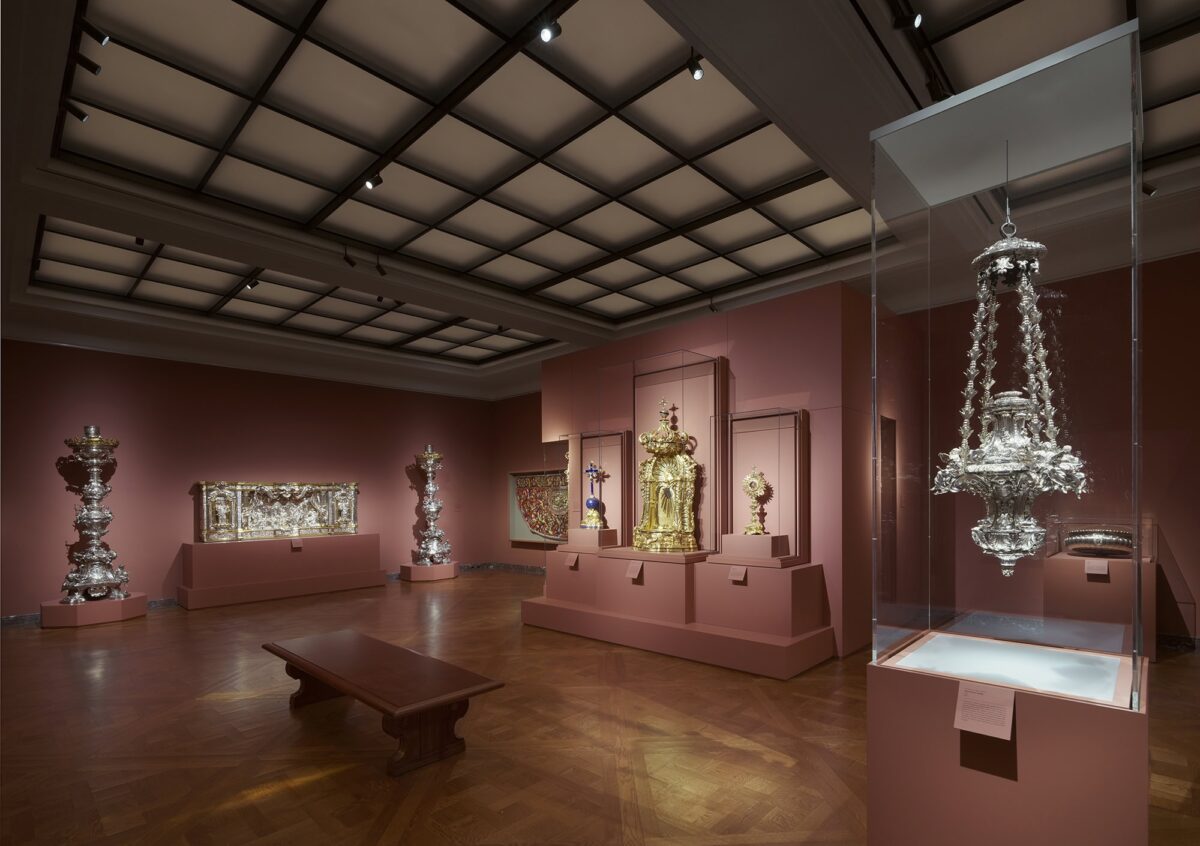
Located in the Frick’s new Ronald S. Lauder Exhibition Galleries just off the iconic Garden Court, To the Holy Sepulcher includes about forty objects in three rooms. This isn’t a lot in number, but the generally large size and incredible detail of these objects means that you’ll have plenty to see and be amazed by. The precious metalwork includes gold, silver, and gem-studded liturgical vessels like chalices and patens, candlesticks, croziers (Bishop’s staffs), crosses, lamps, altar frontals, and more. There are also several examples of something called a Throne of Eucharistic Exposition, which is a small, heavily-decorated throne sometimes used to display the Eucharist during a Mass. (Don’t worry – this was a new one for me, too!) Nearly every metal object in the show is simply encrusted with decoration, including religious figures, heraldry, and ornament. There’s an entire room of objects that are each covered with the French fleur-de-lys on every available surface! Fortunately, every piece in the show is relatively large, so it’s easy to see and appreciate all this detail. My favorites were the two giant silver torchères (candlesticks) made in Venice, which are taller than I am. I also appreciated two silver relief sculptures from Naples depicting the Resurrection and Pentecost; the craftsmanship on the complex Pentecost scene is particularly amazing.
The other major category of objects in To the Holy Sepulcher is textiles, mainly the richly-embroidered vestments that priests and other religious leaders wear during church services. While priests’ clothing may sound like a letdown after all the gold and silver I’ve just described, that’s actually not the case at all. These fabrics are absolutely incredible; they’re luxurious silks and velvets densely embroidered in gold, silver, and richly-colored threads. The decoration is so heavy on some of these garments that they look almost padded in places, kind of like a puffer coat. Amidst the beautiful reds, purples, and pinks of these vestments, a crimson cope (a sort of cape for the clergy) from Genoa stood out to me. Embroidered with naturalistic plant motifs surrounding a scene of Saint George slaying the dragon, it was the last object in the exhibition and a great note to end on. Not only is the design impressive, but the colors are still spectacularly rich and bright for a garment that’s over three centuries old. In fact, all the objects in the exhibition were in remarkably good condition.
While enjoying the aforementioned cope, I overheard another visitor remark to her friend it was incredible that this object had survived in such great shape, “especially in that part of the world”. I assume she was referring to the near-constant turbulence in the Middle East, but my understanding is that their location is precisely the reason for their endurance. Tucked away in the order’s care in Jerusalem, far away from repeated regime changes and social upheavals in Europe they were protected from the wars, disasters, vandalism, iconoclasm, and overuse that claimed many of their cousins. In fact, it seems that the Terra Sancta treasures sometimes represent the best surviving examples of once-abundant 17th-18th century European metalworking and embroidery traditions. These artworks weren’t really even known to the wider world until fairly recently, and it was only in the 2010s that they started to travel abroad while a new museum (the aforementioned Terra Sancta Museum) is being built for them in Jerusalem. This show at the Frick is their first-ever appearance in North America.
To the Holy Sepulcher: Treasures from the Terra Sancta Museum is on view at the Frick Collection in New York through January 3, 2026. After that, it will travel to the Kimbell Art Museum in Texas and then probably back to Jerusalem, since the new museum is supposed to open in 2027. Given how unique and special these objects are and how rarely they travel abroad, I highly recommend making the time to see them if you’re at all interested.
21st-century Rococo
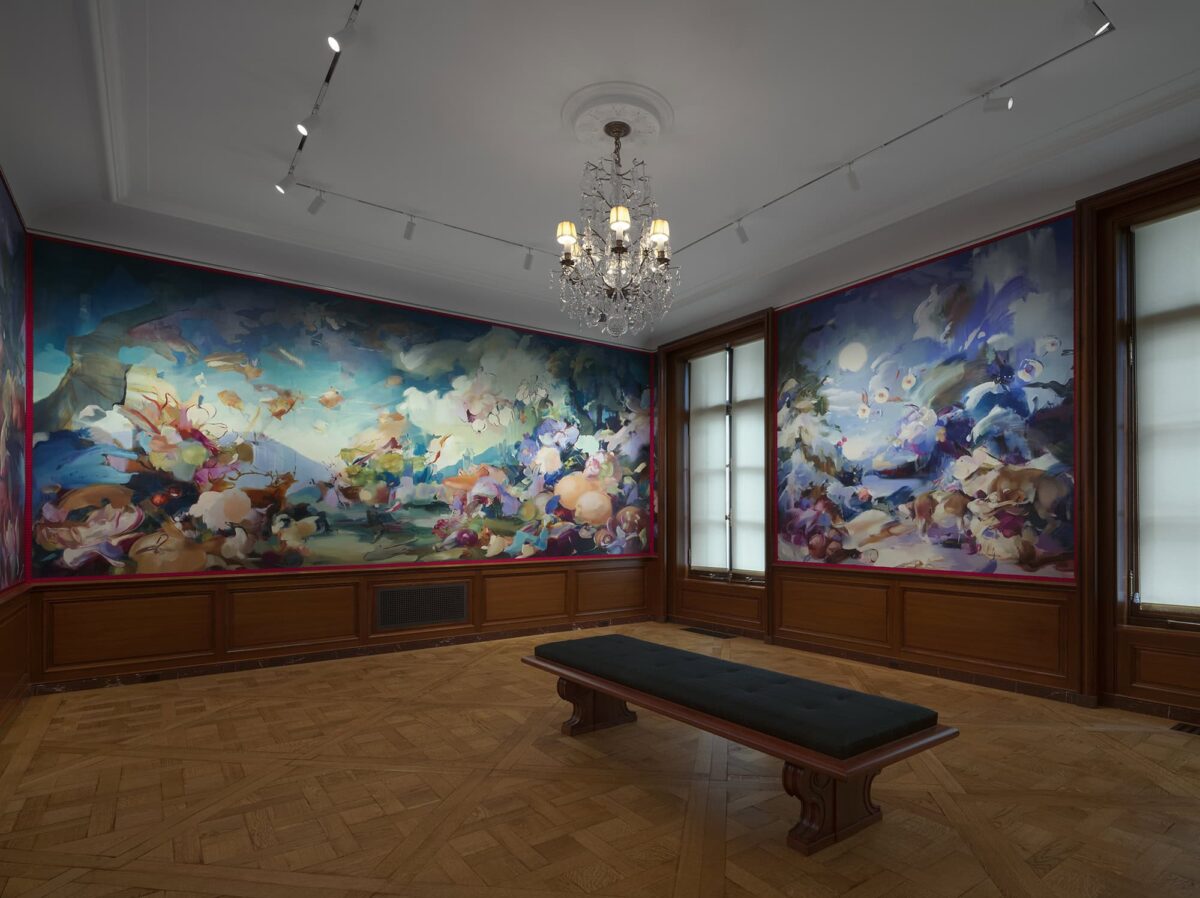
While I was at the Frick, I also spent some time enjoying Flora Yukhnovich’s Four Seasons, a contemporary mural installation in the museum’s Cabinet Gallery. Yukhnovich is a young British artist whose work blends elements of historic Baroque and Rococo painting with abstraction, and this site-specific commission represents her response to the Francois Boucher’s Four Seasons paintings at the Frick. (These Bouchers are located in the nearby West Vestibule; they’re not the paintings in the Boucher Room upstairs.)
The Cabinet Gallery is a fairly small space, and these large, colorful, gestural canvases on all four walls make it into a wonderfully immersive experience. Featuring oversized flowers and fruits inside dreamlike landscapes, Yukhnovich’s paintings seem to exist on the boundary of familiar and unreal. They set a powerful mood that envelopes you when you walk into the gallery. What looks like a person, animal, or landscape element from one vantage point is a dab of paint from another, and it would be easy to spend a lot of time looking at these forms and having different impressions of what they mean. In a course I recently took about abstract art, the professor specifically mentioned Yukhnovich as an artist who plays with the ambiguity of representation versus abstraction to great impact. I totally agree based on my own experience here. The overall effect reminded me of a preparatory sketch, where all the major elements are suggested but not really defined, and also of John Singer Sargent’s travel watercolors, which have a similar effect.
I believe that this is the first contemporary exhibition I’ve ever attended at the Frick, and it confirmed my impression that the museum tends to make really good choices in this area. The paintings complement the permanent collection well in both aesthetics and ideas, unlike the jarring contrasts that so often occur when historical museums venture into contemporary art. Flora Yukhnovich’s Four Seasons is on view at the Frick through March 9, 2026.
Details
If you want to visit the Frick, especially before the end of the year, make sure to buy a timed-entry ticket well in advance online. (Some time slots were already sold out when I booked the night before.) The museum was packed during my Saturday visit – there were short lines to get into both the Terra Sancta exhibition and the gift shop! – and it’s only going to get worse as we get into the holiday break. It did seem like people were getting in from the lengthy standby line, but I wouldn’t take that gamble personally. At least on the day of my visit, they would not let anyone inside more than 15 minutes before their scheduled entry time, so don’t get there too early if it’s cold outside.
While I was there, I got to try the Frick’s new coffee bar, which is located on the bottom level near the auditorium. (No, you cannot get in early to eat before your entry slot. I asked.) The hot chocolate and pastry were both delicious, but you should be aware that the food options are limited to a few different baked treats. This is a place for a snack, not a meal. The Frick does have a sit-down restaurant on the second floor near the gift shop, but you need a reservation and can’t make one until you get inside the building. I’m pretty sure it fills up quickly.